

tri-light
Role
Solo Designer
Duration
6 Weeks
Software Tools
Solid Works, KeyShot, foamcore, 3D printing, LED strips
Delivered
Working prototype, final CAD and renders, app concept

The problem
Beginner creators can tell a shot looks flat. They can't tell why.
Persona: Jamie, 22. Communications major who just found content creation, experimenting with photo and video.
Limited experience
Wants better light without a steep learning curve
Tight budget
A student looking for a real upgrade at low cost
Wants to grow
Uses content to express themselves and build an audience
Small space
Shoots in a dorm room or a small apartment

Context
Key insight
Lighting isn't a gear problem. It's a learning problem.
"The most unaddressed problem is the learning curve that comes before being able to decide a set of preferences."
Discovery
Research
Experiment
Mistakes
Feedback
Skills
Integration

The core idea
Why three? The three-point lighting rule, built into the product
Key, fill and back light is the first lesson in any lighting course. Tri-Light makes each one a panel you can hold, place and switch on one at a time.


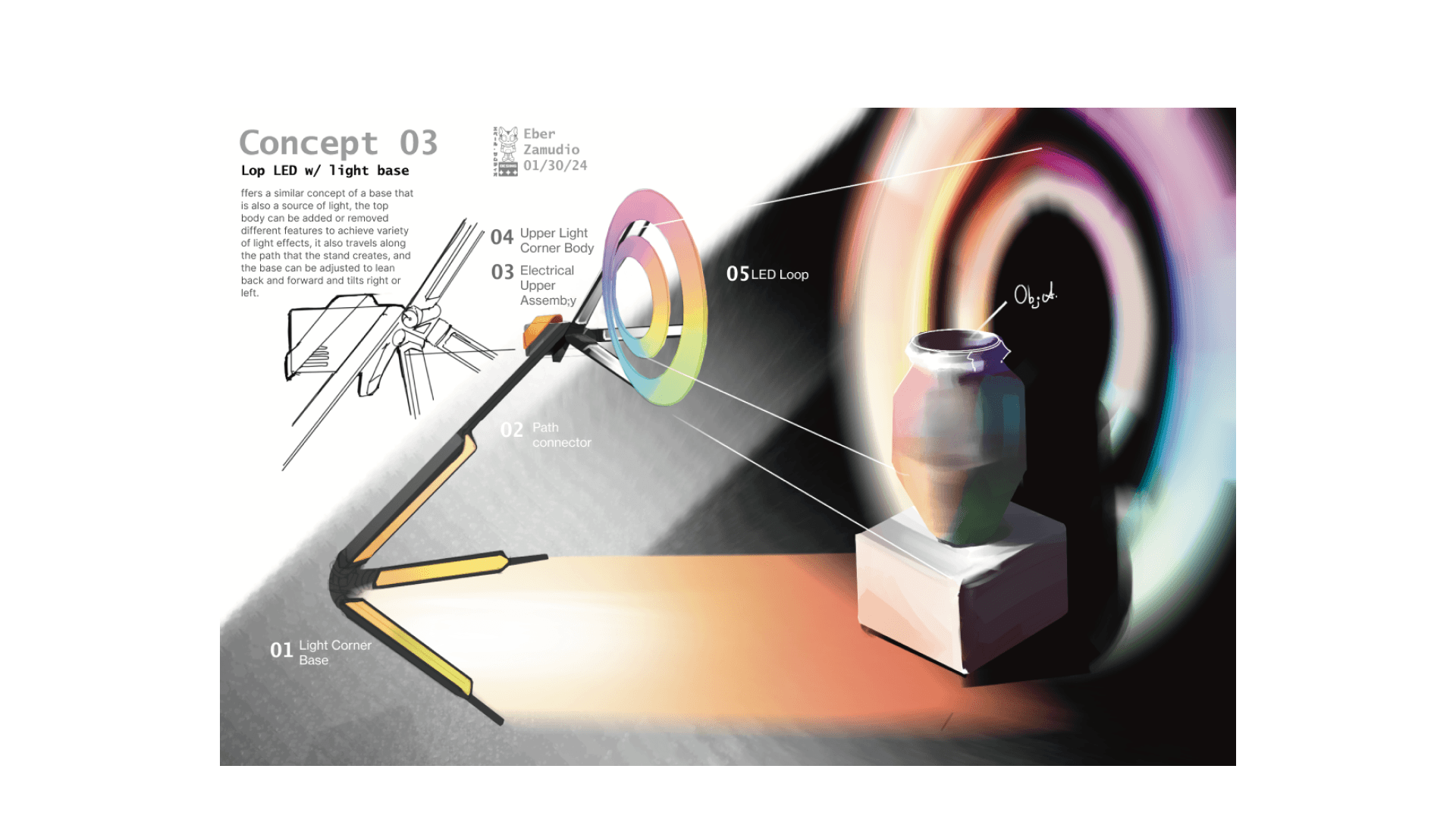


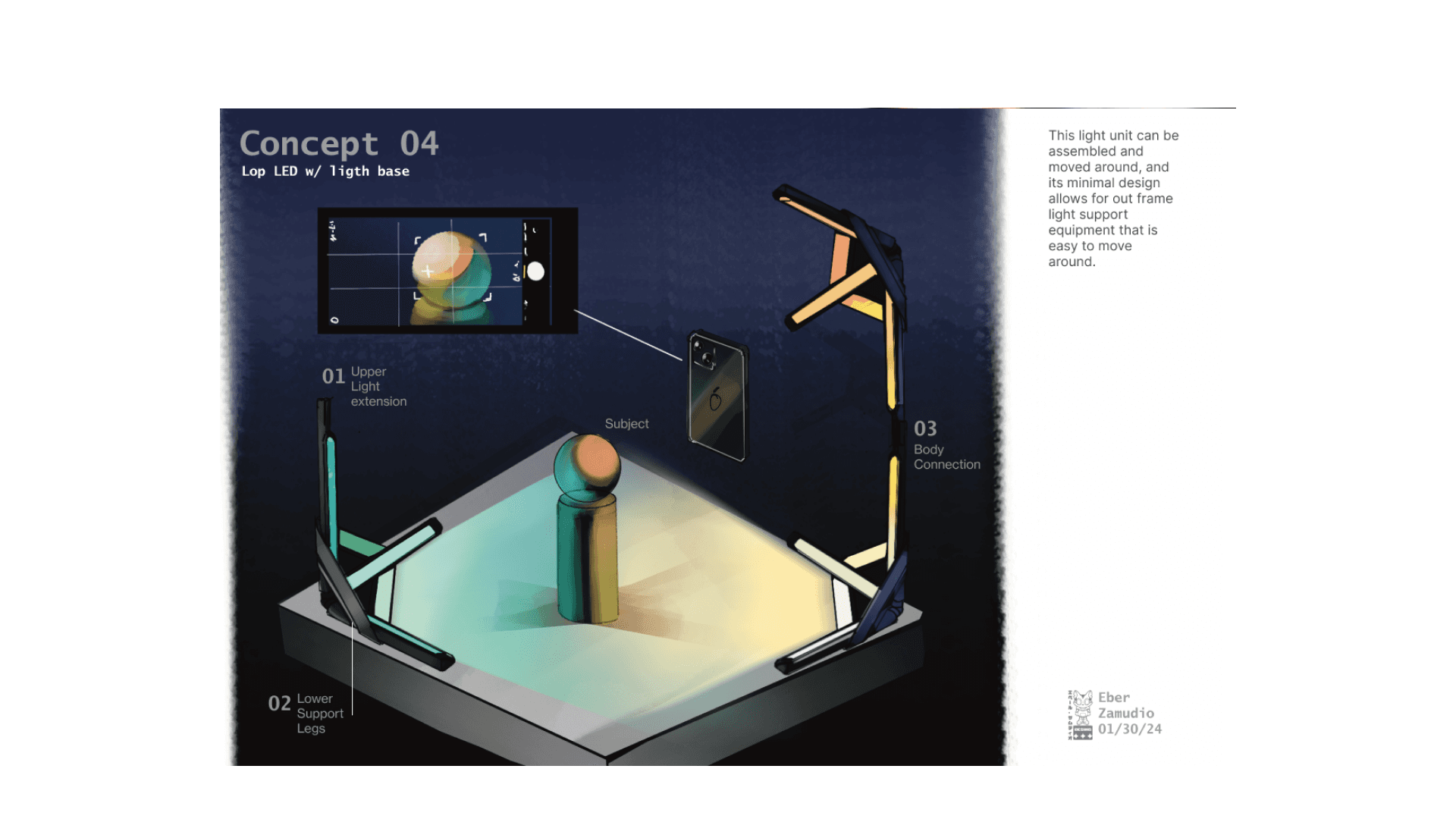
Four quick models to find the triangle
01 Magnetic sticks that snap into a tri-shape, like light bulbs
02 Wider and more rigid for scale, wiring room and swappable lights
03 Triangle frame added for structure, with an open center
04 Tests 02 and 03 linking with other units

Refined form and material exploration
3D-printed tripod
Tightening screws fixes the legs in place
Cork
Friendly texture, easy to grip
Steel screws
Worked well; thread holes need a fillet
Mylar diffuser
Hot spots on close LEDs

Joints
After many test pieces: solid metal ball joints with high-friction lubricant
Controls
Users needed to set one leg or all three fast, so each leg got a display and rotary knob
Size
Fits in a bag; estimated 25% smaller with the right material

Does it make the subject stand out?
Test goal: an auxiliary light should help the subject stand out and carry a stronger emotion.
Two College of Design participants, Feb 21, 2024, outdoors on campus at night. Canon camera, Tri-Light prototype as main light, a temperature panel as secondary.


First model · Fall 2023
Dark blue, light gray-yellow, gray, steel, cork, aluminum
The first Tri-Light: cork, clear light bars, a tripod hinge

Design Refinement
After testing the works-like prototype there were a few areas of impvement


In use
A creator's first ten minutes
1 Unfold
2 Open the app
3 Place panels
4 Shoot
One product. Three lights. Infinite setups.
Color gradient dial
Physical travel dial — warm to cool. One finger. Immediate feedback.
Light intensity slider
Linear slider with Kelvin spectrum control — 2800 to 6500K on-panel.
Mode buttons
Iconographic buttons — power, color, RGB — designed to be recognized without a manual.


Eber Zamudio
ID Portfolio
Tri-Light Project